When to visit the statue
The statue looks much the same in every season, but the line in front of her does not. A weekday morning in February and a Saturday afternoon in July are two different days out. This guide goes through the year month by month, then hour by hour, and ends with how far ahead to book.
The harbor through the year
New York highs climb from about 39 °F (4 °C) in January to about 62 °F (17 °C) in April and 85 °F (29 °C) in July, then fall back to about 65 °F (18 °C) by October. Out on the water it feels colder and windier than on the street, in every month, so a layer you might skip in Midtown earns its place on the ferry deck.
- Winter, December to February. Wind across the open harbor cuts through a light coat, and the days are short. Once the holiday weeks are over, crowds thin out, and late January into early March is the calmest stretch of the year;
- Spring, March to May. April brings mild days around 62 °F (17 °C). Spring break brings a surge of families, so check school calendars before picking a week;
- Summer, June to August. Highs around 85 °F (29 °C) come with heavy humidity and the longest lines of the year. Inside the statue the stairs get hot, which matters if you hold pedestal or crown tickets;
- Autumn, September to November. October highs near 65 °F (18 °C) make for comfortable hours on deck. Crowds drop after Labor Day, and November stays fairly quiet until Thanksgiving week.
The monument closes on Thanksgiving Day and Christmas Day. Fog is the other spoiler. On a murky morning the statue can disappear from a cruise boat's deck almost entirely, as several cruise reviewers found. Cruises only pass her anyway, while a landing at least puts you at the base.
Crowds and the quiet weeks
The busy periods stack up. Summer, spring break, the holiday weeks around Christmas and New Year, and weekends all year bring the heaviest lines. On those days the screening before the ferry can eat an hour or more by itself. Add the boarding queues and recent reviewers count anywhere from one to three hours in line, and Statue City Cruises itself warns of waits beyond three hours.
The calm stretches fall between late January and early March and in September after Labor Day. Early November is quiet as well, as long as you stay clear of the holiday week itself. In any month a weekday beats a weekend.
The first ferry and the early afternoon limit
Hour of day matters more than the month. Boats leave Battery Park roughly every 20–30 minutes, and the line builds through the morning. By ExperienceFirst's own account, its first tour of the day waits least, and the later ones meet longer lines. At Walks, only the earliest booking time gets onto the first ferry of the day, which is all the "early access" in that listing's web address amounts to. Nobody reaches the island before it opens, and nobody skips the screening; reserved tickets shorten the ticket line, not the security one.
The afternoon has its own cost. Catch a boat after roughly 1–2 pm and Ellis Island shrinks to a hurried glance, a problem the official ticket's listing flags as plainly as ExperienceFirst's does. Seeing both islands takes 4–6 hours once security is counted, so a late start works only for a Liberty-only visit. Adding Ellis Island to the day has the timings.
Take the earliest slot of the day
ExperienceFirst's guided tour, our pick, says its first departure meets the shortest lines. Book that slot from ~$59, and free cancellation up to 24 hours ahead leaves room to move the date if the forecast turns.
Sunset, light and photos
The statue faces south-east, out toward the harbor mouth. On an evening boat out of Manhattan the sun sits behind her, so sunset pictures tend to come out as a dark outline against an orange sky. If you want her face lit in your photos, morning sun from the east does that job, and the earliest ferry gives you both the light and the shorter line.
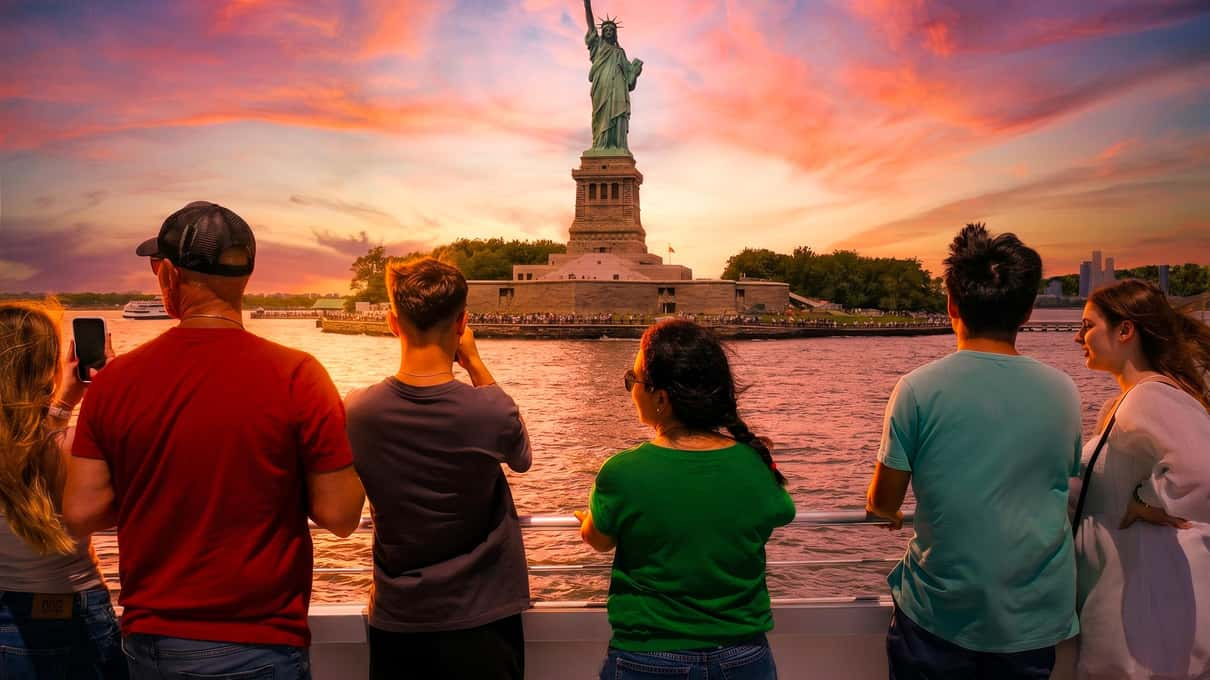
The silhouette is the whole point of an evening cruise. NY Waterway's Golden Hour cruise, from ~$38, spends two hours on the water from Pier 79 at West 39th Street, with a live guide and a photo stop at the statue. A free bus runs afterward. It only passes the statue and never lands. Some departures start in full daylight with the sunset arriving near the end, and Pier 79 takes some finding.
By day, the schooner Adirondack from Chelsea Piers, from ~$60, spends about 1 h 45 min under sail, heading down the Hudson to the statue with Ellis Island off to one side, and one drink is included. It sails from spring to autumn, so check the dates, since it does not go out every day. There is no formal guide, and the deck can feel crowded. Like every cruise here, it passes the statue without landing, and harbor cruise or island landing weighs the two kinds of trip.
How far ahead to book
In summer and on holiday weekends, book a guided tour a few days to a week ahead, and earlier if you want the first slot of the day, since that one goes first. Crown tickets are another matter. Statue City Cruises sells them in small numbers and they often sell out weeks or months ahead, which is why crown or pedestal tickets come before anything else in the plan.
Booking early carries little risk on most tours. The guided tours and the cruise cancel free until 24 hours before, and so does the official ticket on GetYourGuide. The exception is Viator's version of the official ticket at ~$31, which cannot be refunded or changed, not even for rain.
Rain and wind on the day
Tours run in rain or shine, and ExperienceFirst and Babylon both say so in their listings. The supplier may still cancel for bad weather. Wind matters more on the open deck, so pack a hood rather than an umbrella. Visiting with children? The statue with kids adds their side of the timing, and free views work in any weather.